



Listen… if you live in Northwest Arkansas, you don’t need a Census report to tell you we’re growing.
You can see it in the traffic. You can see it in the new neighborhoods. You can see it when the restaurant you used to walk into on a Friday night suddenly has a 90-minute wait.
Bentonville, Rogers, Centerton and Bella Vista are getting bigger—and fast.
But that got us wondering about something most people probably aren’t thinking about while sitting on I-49:
Do we have enough dental offices, dentists and dental staff to take care of everyone moving here?
So, instead of guessing, we started digging.
And then we did something even more old-fashioned.
We picked up the phone.
We Called Every General Dental Office We Could Find
To get a better picture of the dental industry in this part of Northwest Arkansas, we identified approximately 63 general dental offices operating in Bentonville, Rogers, Centerton and Bella Vista.
We excluded specialty-only offices such as orthodontic, pediatric and oral surgery practices because we wanted to look specifically at offices providing everyday general dental care.
Then we personally called them.
Our goal was simple: find out how many dental hygienists were actually working in these practices and combine that information with the number of dentists, offices and people they are serving.
After compiling the data, we estimated that these four cities currently have approximately:
- 63 general dental offices
- 106 dentists
- 161 dental hygienists
Now, here’s where it gets interesting.
During those calls, we heard comments from a few offices along the lines of:
“We need more hygienists.”
And listen… we’re not saying they don’t.
An individual dental office can absolutely be understaffed.
But when you zoom out and look at the entire four-city market, the numbers tell a slightly different story.
Right Now, NWA Appears to Have Enough Hygiene Capacity
The latest official U.S. Census estimates put the combined 2025 population of Rogers, Bentonville, Centerton and Bella Vista at roughly 201,700 people.
Based on recent growth trends, our model puts the combined 2026 population at approximately:
208,195 people
Next, we needed to estimate how many people regularly use dental care.
An American Dental Association Health Policy Institute survey previously reported that 52.3% of adults said they visited a dentist every six months.
For this analysis, we used that 52.3% figure as a market-planning estimate across the population.
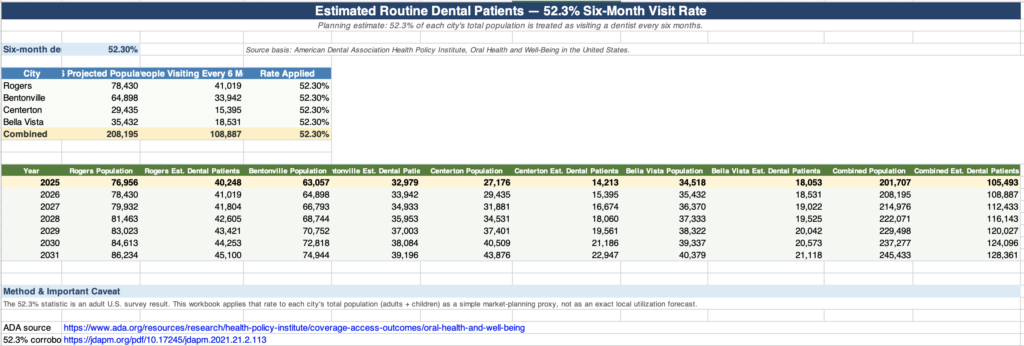
That gives us approximately:
108,887 people receiving routine dental care every six months.
If each of those patients needs two hygiene visits per year, that’s about:
217,774 hygiene appointments annually.
For our capacity model, we used a conservative traditional schedule of:
8 patients per day × 4 days per week × 50 weeks = 1,600 appointments per hygienist per year.
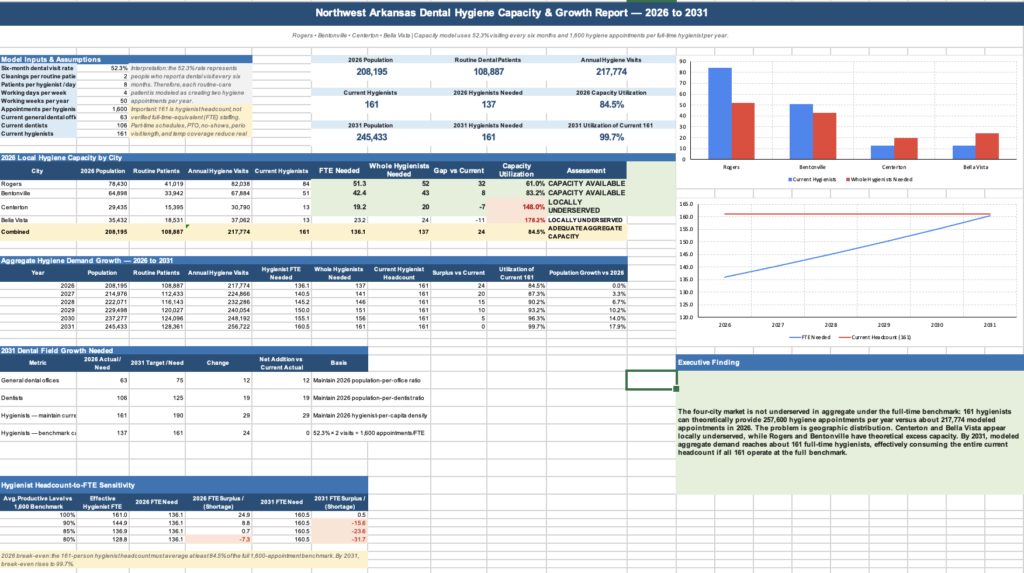
At that level of production, Northwest Arkansas would need approximately:
137 full-time-equivalent hygienists.
Our local count found approximately:
161 hygienists.
So, on paper, we currently have enough.
In fact, the math shows a theoretical cushion equivalent to roughly 24 full-time hygienists.
Before anyone starts throwing toothbrushes at us, there’s an important catch.
A Headcount Isn’t the Same Thing as Full-Time Capacity
Those 161 hygienists are people—not necessarily 161 full-time schedules.
Some work four days.
Some work three.
Some work one or two.
Some split their time between offices.
Some schedules include longer periodontal appointments, cancellations, vacations, maternity leave, sick days and all the other little things spreadsheets conveniently pretend don’t exist.
The U.S. Bureau of Labor Statistics specifically notes that many dental hygienists work part time, and some work for more than one dentist.
So when an individual practice says:
“We need another hygienist.”
That can be completely true even though the regional headcount looks adequate.
Both things can be true at the same time.
Welcome to statistics.
Temporary Staffing Matters Too
There’s another piece of the dental workforce that is easy to miss when simply counting employees.
Northwest Arkansas also has temporary dental staffing companies such as Rise Dental Temp Agency, which serves the region by placing temporary hygienists, dental assistants, front-office team members and even dentists into practices that need extra coverage. According to the staffing information we gathered, Rise currently has roughly 20 to 25 temporary hygienists available in the market—on top of the 161 hygienists included in our office-by-office count. That gives local practices another layer of flexibility and helps explain why the true available workforce may be larger than a simple employee headcount suggests.
That means the local workforce has some flexibility built into it.
If a hygienist is sick, takes maternity leave, goes on vacation or an office suddenly has an open schedule, temporary professionals can step in and keep patients moving through the practice.
These temporary hygienists aren’t necessarily reflected neatly in an office-by-office headcount because the same person may work at several different practices throughout the month.
That makes it even harder to look at one practice’s staffing number and declare that Northwest Arkansas has a shortage.
The dental workforce is more fluid than that.
The Workforce Isn’t Evenly Distributed
When we break our numbers down by city, things get even more interesting.
Using our 2026 population projections and the same assumptions, we estimate:
| City | Current Hygienists | Estimated Needed |
| Rogers | 84 | 52 |
| Bentonville | 51 | 43 |
| Centerton | 13 | 20 |
| Bella Vista | 13 | 24 |
At first glance, Rogers looks like it’s swimming in hygienists while Centerton and Bella Vista are fighting over the last one.
But it’s not that simple.
People don’t necessarily go to the dentist in the city where they sleep.
Someone may live in Centerton and drive five minutes into Bentonville. A Bella Vista resident may see a dentist in Rogers. Practices near major employment centers may draw patients from several surrounding communities.
So these numbers should not be interpreted as “Rogers has 32 unnecessary hygienists.”
They tell us something more useful:
Dental capacity in Northwest Arkansas isn’t distributed evenly.
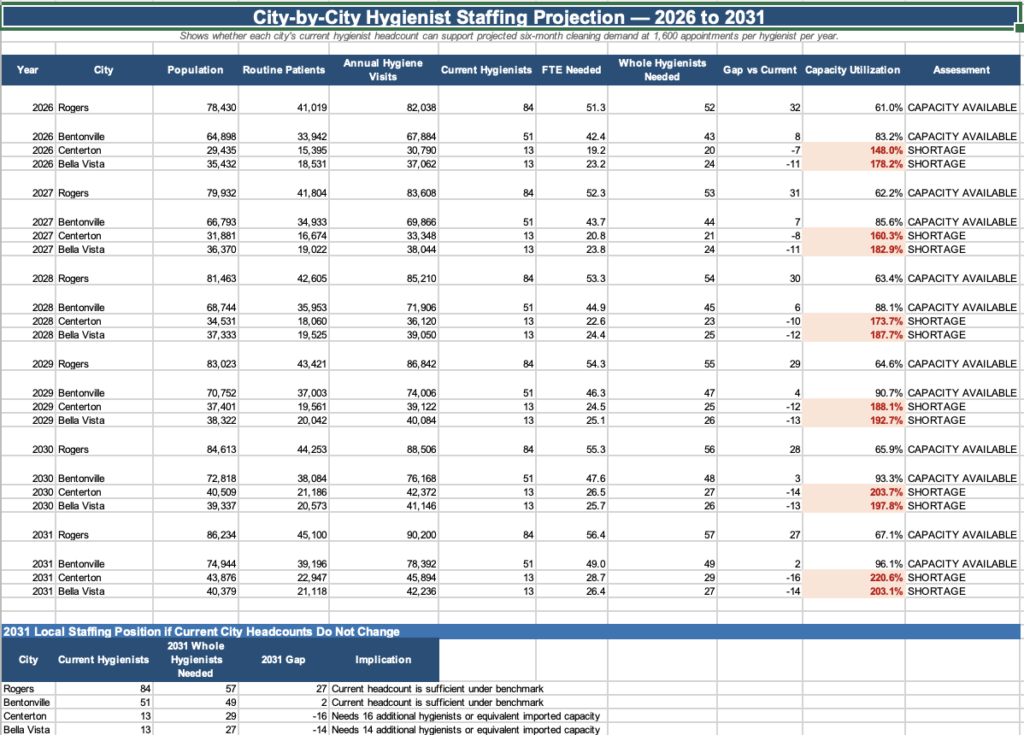
And that becomes increasingly important as the population grows.
Centerton Is the Number That Should Get Everyone’s Attention
Centerton’s growth is remarkable.
The Census estimates its population increased from roughly 17,900 in 2020 to more than 27,000 by 2025.
That’s approximately 52% growth in five years.
No, that’s not a typo.
Meanwhile, Bentonville, Rogers and Bella Vista have continued growing as well.
If recent growth trends continue, our model projects the combined population of the four cities could reach approximately:
245,433 people by 2031.
That’s around 37,000 more people than our 2026 estimate in only five years.
Those people will need schools.
Doctors.
Restaurants.
Grocery stores.
And, unless humans suddenly stop growing plaque, dentists.
By 2031, the Cushion Almost Disappears
At a projected population of 245,433 in 2031, our model estimates approximately:
128,361 routine dental patients
requiring approximately:
256,722 hygiene appointments every year.
Remember the theoretical annual capacity of today’s 161 hygienists at our 1,600-appointment benchmark?
257,600 appointments.
Now compare them:
Estimated 2031 demand: 256,722
Current theoretical capacity: 257,600
That’s a difference of only:
878 appointments for the entire year.
At that point, we’re not talking about a cushion.
We’re talking about a rounding error wearing scrubs.
And that assumes the current workforce remains in place and collectively operates near the full capacity used in our model.
Real life tends to be a little messier than that.
What About Dentists and Dental Offices?
Hygiene isn’t the only part of the equation.
Today, our research found approximately 63 general dental offices and 106 dentists serving the four communities.
With a projected 2026 population of 208,195, that’s roughly:
One general dental office for every 3,300 residents
and
One dentist for every 1,960 residents.
If Northwest Arkansas wants to maintain approximately those same population-to-provider ratios through 2031, our model suggests the area would need roughly:
75 general dental offices
and
125 dentists.
That’s approximately 12 additional offices and 19 additional dentists compared with today’s count.
Those aren’t predictions.
Nobody is claiming exactly 12 dental offices will suddenly appear between now and 2031.
They’re benchmarks showing how much the dental industry would need to grow simply to maintain roughly the same availability we have today.
Then Why Are Some Patients Already Waiting Months?
This may be the most important part of the discussion.
Some dental offices in Northwest Arkansas are already reporting long waits for people trying to become new patients.
How can that happen if the area technically has enough dental professionals?
Because regional capacity and access to a particular dental office are two very different things.
A practice may simply have more people wanting appointments than its team can accommodate.
One area may be growing faster than another.
A hygienist may only work two or three days.
A dentist may already have a large established patient base.
An office may intentionally limit how many new patients it accepts.
Or hundreds of patients may all be trying to get into the same handful of highly reviewed or conveniently located practices.
So when someone says:
“It took me three months to get into a dentist.”
We shouldn’t dismiss that experience because a spreadsheet says Northwest Arkansas has enough providers.
The spreadsheet is measuring the forest.
That patient is standing in front of one very busy tree.
Insurance Access Standards vs. Real-World Dental Capacity
There’s another wrinkle in all of this: dental insurance networks.
Insurance companies and regulators often use what are called network adequacy or access standards to determine whether a provider network gives members reasonable access to care.
Those standards can look at things such as how far a patient has to travel, appointment wait times, the number of providers relative to enrollees and whether providers are accepting new patients.
Exactly how those standards work varies by insurance plan and jurisdiction.
As one example, Maryland’s dental network adequacy rules use a 45-day standard for routine dental services. Federal rules for certain Marketplace networks similarly require enough providers so services are available without unreasonable delay.
But here’s the real-world problem:
An available dentist somewhere in a network isn’t necessarily the same thing as convenient dental access.
Imagine an insurance network technically has an office with an opening.
Great.
But maybe it’s across town.
Maybe it’s in another community.
Maybe that dentist doesn’t offer the services the patient needs.
Maybe the office has poor reviews.
Maybe its hours don’t work for the patient’s family.
Or maybe the patient simply does their research and decides that practice isn’t where they want to receive care.
Patients don’t choose dentists by throwing a dart at an insurance directory.
Location matters.
Services matter.
Technology matters.
Reputation matters.
Trust matters.
And choice matters.
That’s why an insurance network can technically satisfy an access requirement while a patient can still feel like finding the right dentist is difficult.
Sometimes the Bottleneck Isn’t Just Hygiene
This also explains why a long wait for a new-patient appointment doesn’t automatically mean:
“We need more hygienists.”
Dental capacity includes much more than one position.
An office needs:
- Dentists
- Hygienists
- Dental assistants
- Treatment rooms
- Equipment
- Front-office support
- Doctor time
- Hygiene time
- Enough hours in the day to put all of those pieces together
You can hire another hygienist tomorrow, but if you don’t have an available treatment room or enough dentist time for exams, you haven’t necessarily increased your real capacity.
That’s why we think “dental capacity” is a better way to describe the issue than simply calling it a workforce shortage.
Insurance Participation Can Be Part of the Equation Too
Growing patient demand can also put pressure on the relationship between dental practices and insurance networks.
When reimbursement pressure, staffing costs and increasing patient volume all collide, practices have decisions to make.
Some may limit new-patient appointments.
Some may stop accepting certain plans.
Others may choose to leave insurance networks altogether.
That doesn’t necessarily mean an office wants fewer patients.
Sometimes it means the practice is trying to balance the number of patients it can realistically serve with the amount of time, staffing and resources required to care for them well.
And as Northwest Arkansas grows, that balancing act may become increasingly important.
So, Do We Need More Dental Offices, Dentists and Hygienists?
Yes.
But the data does not show that Northwest Arkansas is currently facing some massive region-wide dental staffing catastrophe.
So far, the dental community appears to have done a pretty good job keeping up with extraordinary population growth.
The more interesting question is:
How much longer can that continue?
Right now, our model suggests the four-city area has enough total hygiene capacity.
By 2031, that theoretical cushion is essentially gone.
Meanwhile, certain cities are growing much faster than others, individual practices are already reporting staffing challenges, some patients are experiencing lengthy waits to establish care, and the existing workforce includes a mixture of full-time, part-time and temporary professionals.
Nationally, the Bureau of Labor Statistics projects employment of dental hygienists to grow 8% from 2025 through 2035, much faster than the average for all occupations, as demand for preventive dental services continues to increase.
Northwest Arkansas may need to move even faster in certain communities.
The Bottom Line
Listen… there isn’t a dental-care crisis in Northwest Arkansas today.
That’s actually good news.
We have a substantial number of dentists, hygienists and dental practices taking care of a rapidly growing population.
But population growth doesn’t ask permission before showing up.
If Bentonville, Rogers, Centerton and Bella Vista continue growing at anything close to their recent pace, the dental industry will have to grow with them.
More dentists will be needed.
More offices will likely be needed.
More hygiene capacity will be needed.
And perhaps most importantly, that capacity needs to grow where the people are actually moving.
Today, the numbers suggest we’re keeping up.
Five years from now?
That’s where it gets interesting.
About This Analysis
This analysis is intended to provide a reasonable look at dental-care capacity in Bentonville, Rogers, Centerton and Bella Vista—not a precise prediction of future healthcare utilization.
Our local provider counts were developed by identifying general dental practices in the four cities and personally contacting offices to collect staffing information. Specialty-only practices were excluded. Staffing changes frequently, and reported hygienist counts may include full-time, part-time, temporary or shared team members.
Population figures are based on U.S. Census Bureau estimates, while 2026–2031 figures are projections based on recent population-growth trends. The 52.3% six-month dental-visit figure comes from national adult survey data and was applied to the total local population as a market-planning estimate. Actual utilization in Northwest Arkansas may differ.
The goal isn’t to claim we know exactly what Northwest Arkansas dentistry will look like in 2031.
It’s to use the data we have today to ask a pretty important question:
Are we growing our dental-care system as fast as we’re growing our community?