


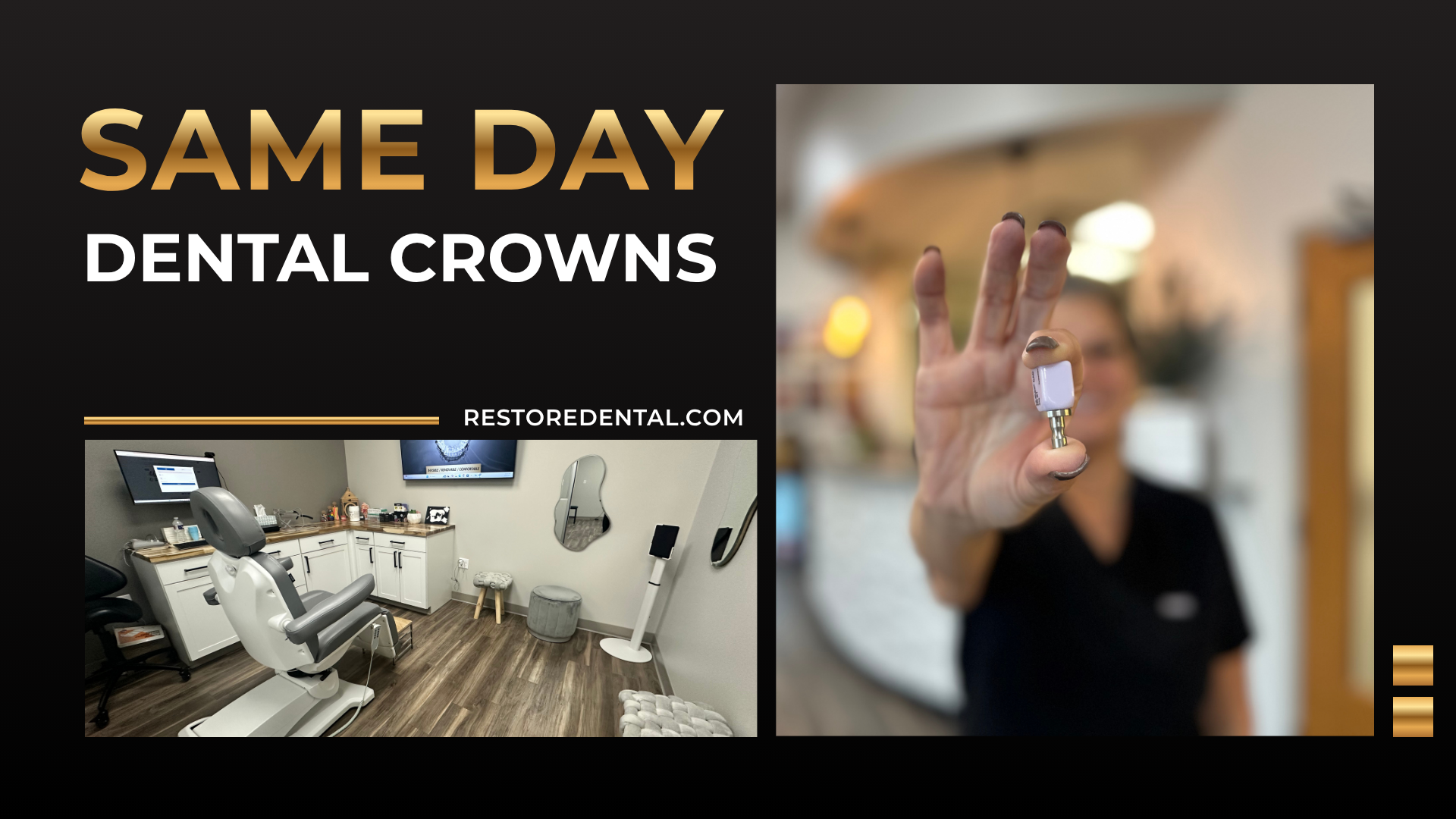
Imagine walking into your dentist’s office with a damaged, weakened, or cosmetically imperfect tooth and walking out that same day with a beautifully restored smile. Thanks to advancements in digital dentistry, what once required multiple appointments, messy impressions, and temporary crowns can now often be accomplished in a single visit.
Modern dental technology has transformed the way dental crowns are designed, created, and placed. With advanced 3D scanning, computer-aided design, and in-office CEREC milling technology, dentists can create custom restorations with remarkable precision, efficiency, and attention to detail.
Whether you’ve chipped a tooth, recently undergone a root canal, or simply want to improve the appearance of your smile, a same-day dental crown may be the solution you’ve been looking for.
What Is a Same-Day Dental Crown?
A dental crown is a custom-made restoration that covers the visible portion of a tooth, helping restore its strength, shape, function, and appearance.
Traditionally, getting a dental crown involved at least two appointments. During the first visit, the dentist would prepare the tooth, take physical impressions, and place a temporary crown. Those impressions would then be sent to an outside dental laboratory, where a permanent crown would be fabricated over the following days or weeks.
Today, CEREC technology makes it possible to design, manufacture, and permanently place many dental crowns in just one appointment.
CEREC, which stands for Chairside Economical Restoration of Esthetic Ceramics, combines digital impressions with CAD/CAM technology to create custom dental restorations directly in the dental office.
CAD/CAM stands for Computer-Aided Design and Computer-Aided Manufacturing. This sophisticated technology allows dentists to digitally design a crown and send that design to a precision milling machine that creates the restoration from a high-quality dental ceramic block.
The result? A custom dental crown designed specifically for your smile, often without the need for a temporary crown, an outside laboratory, or a second appointment.
Who Is a Good Candidate for Same-Day Dental Crowns?
Same-day dental crowns aren’t just for severely damaged teeth. They can address a wide variety of restorative and cosmetic concerns.
Some of the most common reasons patients consider same-day dental crowns include:
Chipped or Broken Teeth
Accidents happen. Whether you’ve chipped a tooth while eating, experienced an injury, or discovered a broken portion of your tooth, a dental crown may be able to restore its original shape, strength, and appearance. For teeth with more significant damage, a crown can help protect the remaining natural tooth structure.
Teeth That Have Undergone Root Canal Treatment
Teeth that have received root canal treatment may need additional protection, particularly back teeth that withstand significant chewing forces. A custom dental crown can help reinforce the tooth and reduce the risk of future fractures when a crown is clinically indicated.
Weak, Cracked, or Worn Teeth
Teeth weakened by large fillings, extensive wear, or certain types of cracks may benefit from the additional protection of a crown. By covering and supporting the remaining tooth structure, a crown can help restore comfortable chewing and everyday function.
Severely Discolored Teeth
Some forms of tooth discoloration don’t respond well to professional whitening treatments. When discoloration is significant, a carefully designed ceramic crown may provide a more consistent, natural-looking appearance while addressing other restorative needs.
Cosmetic Smile Makeovers
Dental crowns aren’t exclusively used to repair damage. They can also play an important role in cosmetic dentistry by improving the size, shape, color, and overall appearance of teeth.
For patients seeking a smile makeover, crowns may be incorporated into a personalized treatment plan to create a more balanced, harmonious smile.
Crooked or Misshapen Teeth
In certain situations, crowns can improve the appearance of mildly irregular, undersized, or misshapen teeth. However, crowns don’t physically straighten teeth, and orthodontic treatment may be a healthier, more conservative option when significant alignment concerns are present.
Gaps Between Teeth
Depending on the size of the spaces and the condition of the surrounding teeth, custom crowns may help improve the appearance of certain gaps. Digital smile design allows dentists to carefully evaluate tooth proportions and determine whether crowns, veneers, orthodontics, or another treatment would provide the most natural-looking result.
Not every tooth needs a crown. Smaller chips, minor discoloration, or cosmetic concerns involving otherwise healthy teeth may be better addressed through bonding, veneers, whitening, or clear aligners. A thorough dental evaluation is essential to determining the most appropriate treatment.
The Technology Behind Same-Day Dental Crowns
What makes same-day dental crowns possible is the combination of several advanced technologies working together.
At the center of this process is the Dentsply Sirona CEREC CAD/CAM system, which brings digital restorative design and precision crown fabrication directly into the dental office.
Digital Impressions and 3D Scanning
Instead of relying on traditional impression trays filled with putty-like materials, dentists can use advanced intraoral scanners to capture detailed digital images of your teeth.
These scans are combined to create a highly detailed, three-dimensional model of your mouth. The digital model provides valuable information about the tooth being restored, neighboring teeth, and how your upper and lower teeth fit together.
For many patients, digital impressions offer a more comfortable experience than traditional impressions while providing the precision needed for a custom restoration.
Computer-Aided Design (CAD)
Once the digital impressions are captured, specialized software helps the dentist design your new crown.
Every detail can be considered, including the crown’s size, contours, anatomy, contact points, and relationship with surrounding teeth.
Rather than relying on a one-size-fits-all restoration, the crown is digitally customized to fit your individual dental anatomy and treatment goals.
Computer-Aided Manufacturing (CAM)
After the design is complete, it’s sent electronically to an in-office CEREC milling chamber.
Inside the milling unit, computer-controlled instruments precisely shape a dental ceramic block into the digitally designed crown.
This eliminates the need to ship impressions to an outside laboratory for many routine crown procedures.
The combination of CAD/CAM technology and in-office milling allows the dentist to maintain direct oversight of the restoration from digital design through final placement.
Step by Step: What Happens During a Same-Day Crown Appointment?
One of the most impressive aspects of same-day dentistry is how much can happen during a single visit.
Here’s a closer look at the process, from your initial consultation to the final placement of your permanent crown.
Step 1: Your Initial Consultation and Dental Evaluation
Every successful restoration begins with understanding your individual needs.
Your dentist will evaluate the tooth, discuss any concerns you’re experiencing, and learn what you hope to accomplish with treatment.
Whether your goal is to repair damage, protect a weakened tooth, or improve your smile’s appearance, this initial conversation helps establish the right approach.
Step 2: Digital X-Rays and Detailed Intraoral Photography
Before recommending treatment, your dentist needs a clear understanding of the tooth’s health and surrounding structures.
Digital dental X-rays, when indicated, help evaluate areas that aren’t visible during a routine examination, including the roots, supporting bone, and potential decay beneath existing restorations.
High-resolution intraoral photographs may also be captured using a sophisticated Digital Doc IRIS intraoral camera.
This advanced camera allows the dental team to capture detailed, close-up images of your teeth and display them on a screen.
These photographs can help patients actually see cracks, worn areas, failing restorations, discoloration, and other concerns that might otherwise be difficult to understand.
It’s an important part of patient education, allowing you to see what your dentist sees and better understand the recommendations being made.
Step 3: Creating Your Custom Treatment Plan
Once the examination, X-rays, and photographs have been reviewed, your dentist will discuss the findings and recommend a personalized treatment plan.
This includes determining whether a same-day crown is the most appropriate option, which restoration material to use, and how to achieve the best balance of strength, function, and aesthetics.
Not every situation is suitable for same-day treatment. Teeth requiring additional procedures, complex restorations, or specialized laboratory work may need a different approach.
If a same-day crown is appropriate, the process can often move forward during the same appointment.
Step 4: Making Sure You’re Comfortable
Before beginning treatment, local anesthetic is administered when needed to numb the tooth and surrounding area.
Your comfort remains a priority throughout the appointment, and the dental team will ensure the area is adequately anesthetized before proceeding.
Step 5: Preparing the Tooth
Next, your dentist carefully prepares the tooth to receive its new crown.
This may involve removing decay, addressing damaged or weakened tooth structure, replacing compromised restorative materials, or building up areas that need additional support.
The tooth is then shaped to create the appropriate space and foundation for the custom restoration.
The goal is to preserve as much healthy tooth structure as clinically possible while ensuring the new crown can fit securely and function comfortably.
Step 6: Capturing Your 3D Digital Impression
Once the tooth has been prepared, a digital intraoral scanner captures a detailed three-dimensional impression.
Rather than using traditional impression materials, the scanner records the precise contours of the prepared tooth, neighboring teeth, and opposing bite.
The information appears on a computer screen, creating a virtual model that can be examined from multiple angles.
This digital impression serves as the foundation for the custom crown design.
Step 7: Designing Your Crown in 3D
This is where CAD technology comes to life.
Using specialized CEREC design software, your dentist digitally creates your new crown based on the exact dimensions of your prepared tooth.
The software helps evaluate important details such as:
- The crown’s overall shape and size
- How it fits against neighboring teeth
- The contours of the biting surface
- How the crown interacts with your opposing teeth
- The relationship between the restoration and the gumline
- The natural anatomy and appearance of the tooth
Your dentist can refine the digital design before the crown is ever manufactured.
For cosmetic restorations, this stage is particularly important because even subtle changes in tooth shape and proportions can influence the overall appearance of a smile.
Step 8: Selecting Your Custom Tooth Shade
A beautiful dental crown should complement your natural smile.
Your dentist carefully evaluates the color of your surrounding teeth to select an appropriate ceramic material and shade.
Factors such as brightness, translucency, and natural tooth characteristics can all influence the final appearance.
For patients undergoing cosmetic treatment, shade selection may also be guided by the desired outcome of a larger smile makeover.
The objective is to create a restoration that looks natural and blends appropriately with surrounding teeth.
Step 9: Milling Your Crown in the Sirona CEREC Chamber
Once the digital design has been approved, it’s time to turn that virtual crown into a physical restoration.
The completed design is sent directly to the Sirona CEREC milling chamber, an advanced manufacturing unit located inside the dental office.
A carefully selected block of dental ceramic is placed inside the machine.
Using precision-controlled instruments, the milling unit shapes the block into a crown based on the digital design.
Fine details, including the crown’s anatomical contours and internal fitting surfaces, are created during this automated process.
Depending on the material, milling equipment, and restoration design, fabrication may take only a matter of minutes.
What traditionally required an outside dental laboratory can now often be accomplished right inside the dental office.
Step 10: Custom Characterization and Glazing
Once milling is complete, the crown can be further customized to enhance its natural appearance.
Depending on the ceramic material and aesthetic goals, the dental team may apply subtle characterization, shading, stains, or glaze.
These finishing techniques can help reproduce natural tooth features, including color variations, surface characteristics, and a lifelike sheen.
This combination of digital precision and hands-on artistry is especially valuable in cosmetic dentistry, where attention to small details can make a meaningful difference.
Step 11: Firing the Crown in a Specialized Dental Oven
Certain ceramic crowns require additional heat treatment before they are ready for permanent placement.
Depending on the chosen material, the restoration may undergo crystallization, sintering, or glaze firing in a specialized dental furnace.
This carefully controlled process helps achieve the material’s intended physical properties and final appearance.
For crowns requiring glazing, firing also helps produce a smooth, polished surface with a natural-looking finish.
The exact process varies depending on the type of ceramic selected, but modern chairside dental furnaces are designed to make these steps compatible with efficient same-day treatment.
Step 12: Trial Seating and Checking the Fit
Before permanently placing your new crown, your dentist carefully tries it on the prepared tooth.
This step, often called trial seating, allows the dentist to evaluate the restoration’s fit, appearance, and function.
Special attention is given to how the crown fits against the prepared tooth, how it contacts neighboring teeth, and how it feels when you bite.
Your dentist may make small refinements to ensure that the restoration fits comfortably and functions properly.
For visible teeth, the overall color, contour, and aesthetics are also carefully evaluated.
Step 13: Permanently Seating Your New Crown
Once the fit and appearance have been approved, the crown is ready for permanent placement.
Your dentist prepares the tooth and restoration according to the requirements of the selected material and then secures the crown using an appropriate dental bonding or cementation system.
Any excess material is removed, and the bite is checked again to ensure comfortable function.
After a final inspection, your new crown is complete.
In many cases, you can leave the dental office that very same day with your permanent restoration in place.
You’ll also receive instructions for caring for your new crown, including any temporary eating precautions while the anesthetic wears off.
What Are the Benefits of Same-Day Dental Crowns?
Same-day crowns offer several advantages over traditional crown procedures, particularly for patients who value convenience without sacrificing personalized care.
Fewer appointments: Many patients can complete the entire crown procedure in one visit rather than returning for a second appointment weeks later.
No temporary crown in many cases: Because the permanent restoration is created in-office, patients can often avoid wearing a temporary crown while waiting for laboratory fabrication.
Comfortable digital impressions: Modern intraoral scanning reduces the need for traditional impression materials that some patients find unpleasant.
Precision digital design: CAD/CAM technology allows the dentist to digitally evaluate and customize the crown’s anatomy, contours, and fit.
Personalized aesthetics: Ceramic shade selection, characterization, and glazing help create restorations designed to complement the patient’s natural smile.
Direct oversight: In-office design and milling give the dental team control over much of the fabrication process, from digital impressions through final placement.
Restored function and confidence: A properly designed dental crown can protect a compromised tooth while restoring comfortable chewing and improving its appearance.
Are Same-Day Crowns as Good as Traditional Crowns?
A common question is whether a crown created in a single appointment can offer the same quality as one fabricated by a traditional dental laboratory.
The answer depends on several factors, including the crown material, the condition of the tooth, the accuracy of the design, and the dentist’s clinical technique.
Modern CEREC systems can create high-quality ceramic restorations using materials designed for durability, function, and natural aesthetics. Same-day crowns can perform well when appropriately selected, fabricated, and maintained.
However, not every restoration is best completed in a single visit. Some highly complex cases, challenging cosmetic situations, or teeth requiring additional treatment may benefit from specialized laboratory fabrication.
The most important factor isn’t necessarily how quickly a crown is made. It’s whether the restoration is properly designed, fits accurately, protects the tooth, and supports long-term oral health.
How Long Does a Same-Day Dental Crown Last?
A well-made dental crown can last for many years, but its lifespan depends on the material used, your oral hygiene habits, bite forces, and overall dental health.
Many crowns last 10 to 15 years or longer, although individual results vary.
Brushing twice daily, cleaning between your teeth, attending regular dental appointments, and avoiding habits like chewing ice can help protect your restoration.
If you grind or clench your teeth, your dentist may also recommend a protective night guard.
Remember, even though the crown itself cannot develop a cavity, the natural tooth underneath it can still experience decay. Consistent preventive care remains essential.
Can You Really Walk In With a Damaged Tooth and Leave With a New Crown?
In many cases, yes!
One of the greatest advantages of modern digital dentistry is the ability to evaluate, design, fabricate, and permanently place a dental crown during a single scheduled visit.
However, same-day treatment depends on the condition of your tooth, the procedures needed, and appointment availability.
A tooth with significant infection, extensive structural damage, or other complex concerns may require additional treatment before receiving a permanent crown.
And while CEREC technology dramatically streamlines the process, a same-day crown appointment can still take several hours because every restoration must be carefully designed, manufactured, finished, and evaluated.
The goal isn’t simply to create a crown quickly. It’s to combine modern technology, clinical expertise, and attention to detail to deliver a restoration designed specifically for you.
A New Era of Dental Crowns in Bentonville, Arkansas
Same-day dental crowns are a staple at Restore Modern Dentistry in Bentonville, Arkansas, where advanced digital technology meets personalized, aesthetic-focused dental care. Led by two female dentists, Dr. Lindsay English and Dr. Lorna Offutt, our practice brings more than 33 years of combined aesthetic dental experience and multiple cosmetic dentistry awards to the Northwest Arkansas community. With digital impressions, Digital Doc IRIS intraoral photography, advanced CAD/CAM technology, and in-office Sirona CEREC milling, our team combines modern innovation with the artistry and precision needed to create beautiful, functional restorations. Whether you’re dealing with a broken tooth, need to protect a weakened tooth, or are considering a cosmetic smile transformation, our team can help determine whether a same-day dental crown is right for you.