


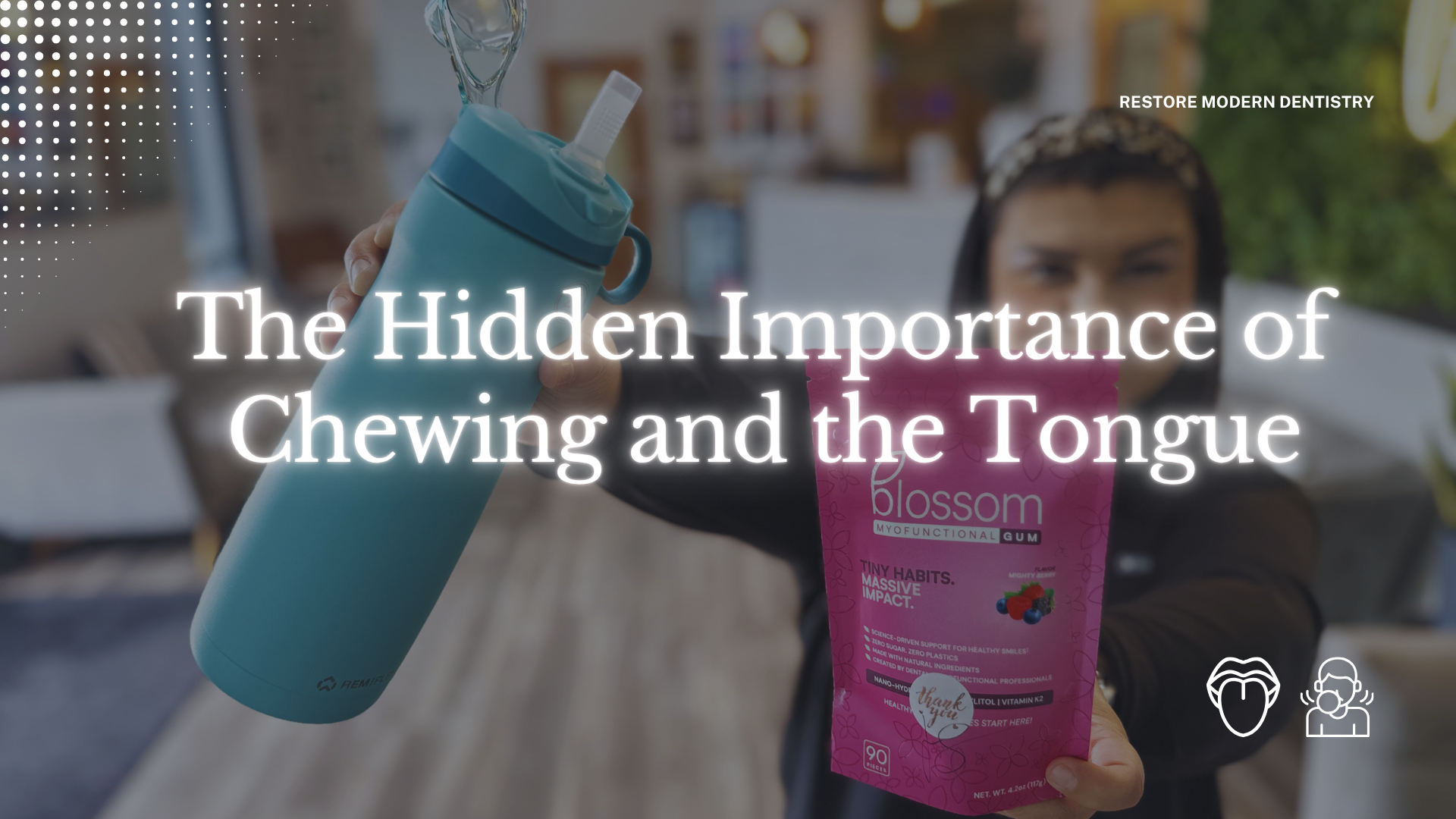
Most people think of chewing as simply part of eating, but chewing and tongue function play a much bigger role in a child’s overall growth and development than many realize. In fact, the tongue, jaws, facial muscles, and airway are all deeply connected.
How a child chews, swallows, breathes, and positions their tongue can influence everything from facial growth and sleep quality to airway health and oral development. As more healthcare providers focus on airway-centered care, the connection between chewing and tongue function is becoming increasingly important.
Why the Tongue Matters So Much
The tongue is one of the most powerful and influential muscles in the body. It affects:
- Breathing
- Swallowing
- Speech
- Jaw growth
- Facial development
- Sleep quality
- Airway stability
Ideally, the tongue should rest fully against the roof of the mouth with the lips closed and breathing happening through the nose. This natural posture helps widen and support the upper jaw as children grow.
When the tongue rests low in the mouth instead, the upper jaw may not fully develop outward. Over time, this can contribute to:
- Narrow palates
- Crowded teeth
- Mouth breathing
- Smaller airway space
- Poor sleep quality
- Improper swallowing patterns
Because the tongue sits so closely to the airway, tongue posture can directly impact how open and stable the airway remains – especially during sleep.
Chewing Is Exercise for the Mouth and Face
Chewing is much more than breaking down food. It is one of the body’s natural ways of strengthening and developing the muscles of the face, tongue, and jaws.
Every time a child chews, the:
- Tongue activates
- Jaw muscles engage
- Cheeks stabilize
- Swallowing muscles coordinate
- Facial bones receive stimulation for growth
This repeated activity helps build stronger oral muscles and supports healthy facial development.
Children who regularly chew tougher, textured foods often develop stronger oral muscle tone and healthier jaw growth compared to children who primarily consume soft, processed foods.
Modern Diets Have Changed Oral Development
Historically, humans consumed foods that required much more chewing effort—fibrous vegetables, meats, nuts, roots, and minimally processed foods.
Today’s diets often consist of:
- Soft breads
- Processed snacks
- Yogurts
- Pouches
- Fast foods
- Foods that dissolve quickly
While convenient, these foods require very little chewing. Less chewing means less stimulation for the tongue and jaw muscles during critical developmental years.
Over time, this reduced muscle activity may contribute to:
- Weak oral muscles
- Underdeveloped jaws
- Limited tongue space
- Mouth breathing habits
- Airway concerns
How Chewing and Tongue Function Affect the Airway
The tongue should fit comfortably inside the upper jaw and rest naturally against the palate. But when the jaw is narrow or oral muscles are weak, the tongue may sit low or fall backward toward the airway.
This can contribute to:
- Mouth breathing
- Snoring
- Restless sleep
- Teeth grinding
- Sleep-disordered breathing
- Poor oxygen quality during sleep
Many common childhood symptoms may actually be connected to airway and oral muscle dysfunction.
Signs parents may notice include:
- Open-mouth posture
- Dark circles under the eyes
- Crowded teeth
- Speech concerns
- Difficulty chewing
- Frequent congestion
- Picky eating with textures
- Restless sleep
- ADHD-like symptoms or difficulty focusing
The Role of Myofunctional Therapy
Myofunctional therapy helps retrain the muscles of the tongue, lips, cheeks, and face to function properly.
The goal is to improve:
- Tongue posture
- Nasal breathing
- Proper swallowing
- Lip seal
- Chewing function
- Oral muscle strength and coordination
By improving oral function, myofunctional therapy can help support healthier airway development and overall wellness in both children and adults.
Science-Backed Products That Support Chewing and Tongue Function
Alongside healthy eating habits and myofunctional therapy, several innovative products can help strengthen oral muscles and encourage healthy tongue and chewing patterns.
Myo Munchee
The Myo Munchee is a myofunctional device designed to encourage proper chewing, tongue posture, lip seal, and nasal breathing.
By activating the muscles of the tongue and face, it may help:
- Strengthen oral muscles
- Encourage healthy tongue positioning
- Improve swallowing patterns
- Promote nasal breathing
- Support healthy jaw development
Many airway-focused dental and myofunctional practices use Myo Munchee as part of a comprehensive approach to oral function and airway health.
REMplenish MYO-Nozzles
REMplenish MYO-Nozzles turn everyday hydration into functional oral muscle training.
These specially designed nozzles provide resistance while drinking, helping strengthen:
- The tongue
- Lips
- Cheeks
- Swallowing muscles
Benefits may include:
- Improved tongue strength
- Better swallowing mechanics
- Increased oral muscle tone
- Reinforcement of healthy oral posture
Because they are used during daily hydration, they provide an easy and consistent way to support oral muscle development.
Blossom Myofunctional Chewing Gum
Blossom Myofunctional Chewing Gum is specifically designed to encourage intentional, functional chewing – naturally.
Unlike traditional gum, it focuses on promoting healthy muscle activity and chewing patterns.
It may help:
- Strengthen jaw muscles
- Increase tongue engagement
- Encourage bilateral chewing
- Improve oral muscle endurance
- Support healthy oral habits
This natural myofunctional chewing gum can be a valuable addition to airway-focused and myofunctional therapy programs for both kids and adults.
Healthy Function Supports Healthy Growth
Chewing and tongue posture are foundational pieces of healthy airway development. When children develop strong oral muscles and proper tongue function early in life, they are better supported for healthy breathing, quality sleep, balanced facial growth, and overall wellness.
At Restore Modern Dentistry, we are passionate about helping families better understand the connection between chewing, tongue function, airway health, and total-body wellness. Our myofunctional therapist, Lindsey Choate, works closely with children and adults to provide education, guidance, and personalized support for healthy oral muscle development, breathing patterns, and airway-focused care. We proudly serve patients throughout Bentonville and surrounding communities including Rogers, Centerton, Bella Vista, Springdale, and all across Northwest Arkansas. If you have questions about myofunctional therapy, tongue posture, airway development, or chewing concerns, our team is here to help educate, support, and guide your family toward healthier function and lifelong wellness.